
Monthly Archives: March 2006

The little corner

This morning we picked up my parents at the airport, and we wanted to stop for lunch somewhere quick, cheap, good, and nearby.

The answer was obvious: [Taqueria El Rinconsito](http://www.elrinconsito.com), a local taco chain with branches all over south Seattle. We went to the one on International Boulevard in Tukwila.

I wish El Rinconsito had Starbucks-esque aspirations, because I think America is ready for it. They serve burritos and enchiladas and the like, but most people come in for tacos and tortas (Mexican sandwiches). The tacos come in all the usual taco-truck flavors: carnitas, cabeza (beef cheek), birria (shredded beef), adobada (spicy pork), pollo, and lengua (beef tongue). Iris loved the tongue. Laurie and I split a six-taco plate, with two each of carnitas, adobada, and pollo. We printed a coupon off the web site and got Iris a free quesadilla plate.

El Rinconsito should be everywhere not just because it’s good, but because it’s good for a snack. Often I’ll find myself wanting a snack but not in the mood for candy, chips, or fruit. Basically, what I want is a miniature version of a meal. Most restaurants don’t cater to that kind of craving. Good Mexican restaurants do. The tacos at El Rinconsito consist of two small corn tortillas topped with about two tablespoons of meat, with salsa, onions, and cilantro. Naturally there’s a salsa bar.

The prices at El Rinconsito are frankly insane. It’s like wandering into a country where the dollar goes farther, or possibly it’s like wandering into the 1950s, with tacos. The tacos are 79 cents. The six-taco plate, with a drink, is $5.79, and you don’t pay extra if you want tamarind juice or horchata instead of soda. Free refills!

Finally, is it wrong to feel an inner glow when you go to an ethnic restaurant and your party is the only one there not of the same ethnicity as the restaurant? I don’t even mean “the food must be good, just look who’s here.” It’s more a “some of my best friends” thing.

This is about as mature as thinking I must be really progressive because I rap along to De La Soul in the car, but c’mon, tell me you don’t feel the same way.

Iris enjoyed El Rinconsito, but then afterwards we took her through the car wash, which completely blew her mind. I think it was more exciting than the zoo, the aquarium, and pizza combined.
Big flavors

I got the new issue of [The Art of Eating](http://www.artofeating.com/) this week, and a letter from David Downie voiced a complaint I’ve heard before:

> During my travels in America I have been treated to so many overloaded, over-spiced, over-complicated dishes at homes and in restaurants that I’ve simply stopped commenting on the phenomenon.

Downie, who lives in Paris, contributes regularly to AoE (he writes about unsalted Italian bread in this issue). Something tells me he wouldn’t have approved of tonight’s dinner.

Dinner consisted of the remainder of the homemade poblano sausage, formed into patties and served on toasted buns (Franz cornmeal kaiser buns, which are great, and wouldn’t Franz the Cornmeal Kaiser make a great Sesame Street character?). For sandwich toppings, we had sauteed mushrooms and homemade tomatillo-chipotle salsa.

Downie doesn’t provide any examples of what he’s talking about, so it sounds to me like he’s elevating a personal preference–or perhaps a matter of physiology–to a moral standard.

Naturally, I wouldn’t profess to like “overloaded” or “over-spiced” food, but I think Thai food is one of the world’s greatest cuisines. I doubt this is a controversial sentiment anymore, and certainly not in Seattle. What makes Thai food special is often described in shorthand as “hot, sour, salty, sweet,” but that’s only half of it. Thai food is the culinary equivalent of Extreme Programming: it’s what you get when you take all of those delicious qualities and turn them up to eleven.

Now, part of the reason I like Thai food is the same reason I like any food: I had a good experience with it, and it resonated with my personal palette of psychological quirks. But another part of the reason is purely physical: I’m a nontaster. That is, I’m physically incapable of tasting the chemical known as PROP. Seventy-five percent of the population finds this chemical unpalatably bitter. My fellow nontasters and I could chug it like Miller Lite. Nontasters, who have far fewer tastebuds than average, tend to have a high tolerance for spicy and bitter foods, as well as extremely sour foods like grapefruit.

I can’t say for sure that Downie is a PROP taster, but it seems likely. He goes on to say:

> Instead of tasting the subtle flavors and rejoicing in the nuances, the respect shown for the unmediated flavors of the ingredients, this distinguished writer found blandness.

The key points that I think Downie is missing are: the cooking of different countries can be great in different ways, and often a nation’s greatest strengths are also its greatest flaws. America’s penchant for big flavors gives us the Big Mountain Fudge Cake with one hand and barbecue with the other. To take this metaphor in a totally gross direction, we can’t just amputate the fudge cake hand. (Big Mountain Fudge Cake is a nasty-looking dessert served at a chain restaurant. I saw it on TV. I am not opposed to fudge cake in general.)

Also, of course, America offers among the world’s best and worst food, and if you come looking to pick a food fight, you’ll find plenty of material.

I went to Paris once. I could have come back complaining that the vegetables were all overcooked, the food was bland, and everything was larded up with too much butter and cream. That would have been silly. Right?

Still life with–oops, I ate the props

Lara Ferroni, Seattle-based publisher of [Cookbook 411](http://www.cookbook411.com/) (and Roots and Grubs reader), has started a new blog called [Still Life With](http://www.stilllifewith.com/), all about food photography. If you’ve been wondering how to improve your food photography, ride along with Lara and she will no doubt explain it all.

On the other hand, if you’ve wondered why Roots and Grubs has few photos, I can explain that. A few years ago I was writing a column for eGullet called Desperate Measures. Their policy was that every article they published required a photo or other illustration.

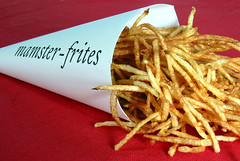
One of the editors was Ellen Shapiro, a very talented professional photographer. She patiently explained the basics of closeup photography to me, told me what kind of lighting to buy, and gave many hints about presentation and props. I ended up taking some pretty good pictures, such as:

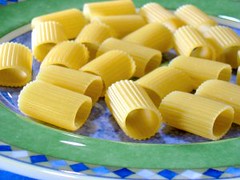
Noodles Frites

Apparently I did especially well with starch.

Anyway, these days there’s just no way I’m going to haul out the lights and shoot several dozen exposures of, say, the delicious cheesy grits I made for breakfast yesterday. Sure, I could forget the lights and post photos that aren’t as good, but when it comes to pictures, I’m too much of a perfectionist to do that. And my camera has terrible low-light performance.

But maybe I’ll pick up some tips from Still Life With.

Crunch it

Iris got four new teeth this week, which is giving me hope that the end of the soft food regime is near. According to Wikipedia:

> In oral anatomy, the canine teeth, also called cuspids, dogteeth, fangs, or (in the case of those of the upper jaw) eye teeth, are relatively long, pointed teeth, evolved (and used, in most species where they remain prominent) primarily for firmly holding food in order to tear it apart, and occasionally as weapons.

Let the fun begin!

As you know, I’m a firm believer that babies and young children can and should eat the same food as adults. I call it [the first rule of baby food](https://www.rootsandgrubs.com/2006/01/12/the-first-rule-of-baby-food/). But, like any rule, there are times when it chafes. There are foods I love that a baby can’t eat, like pork chops (too chewy) or lightly stir-fried vegetables (too crunchy).

But Iris is no baby, and I’ve seen her gnaw her way through a whole apple and a huge pile of cucumbers and eat a mass of Chong Gin Hot Chicken from Seven Stars Pepper, which is equal parts crunchy, chewy, and spicy. (She ate her first apple in the store when I gave her an apple to hold, and when we got up to the cashier I realized that this was different from eating a candy bar in the store, in that you don’t have to weigh a candy bar. We got the apple free. Score!)

Last night I made corned beef and cabbage, and I didn’t let the corned beef braise long enough, so it was a little tough. Iris did not care. She ate it like she’d just survived the potato famine. So I’ve probably been too reticent about introducing crunchier, chewier, and otherwise more challenging foods. She’s outgrown the phase where, upon encountering something too crunchy for her young jaws, she would hand it to me and say, “Dada, crunch it.”

Maybe next week I’ll make Thai beef salad.

Getting loaded

My least favorite chore growing up was emptying the dishwasher. It’s still no fun.

Loading the dishwasher, however, is a treat. It’s like a puzzle. Plus, I get to sing along to my iPod while doing it. I suspect this is very entertaining, because I will sing along with equal gusto to male and female vocals, and it’s possible that my impression of Kelly Clarkson is less than entirely convincing. (I can still love “Since U Been Gone” without having my hipster doofus card revoked, right?)

Before I talk about my dishwasher loading principles, here are a few thoughts on the subject of washing up, from the late Alan Davidson in The Oxford Companion to Food:

> A better way of regarding [washing up] is as the climax of the whole cycle (gathering, preparation, cooking ,eating) and as a piece of ritual which should have engaged the attention of anthropologists and the like to a much greater extent than the questions which have tended to preoccupy them, such as whether food is boiled or roasted. The purification of the utensils has to be the final, culminating stage of any meal, the stage which in effect sets the scene for the next meal and permits life’s processes to continue.

Yep, that’s pretty much what I was thinking while loading the dishwasher last night and singing along to the debut album by Seattle pop-punkers The Lashes. Anthropologists and the like, prepare to be schooled, bearing in mind that I have a basic model of dishwasher and have been using it for less than two years. Hmm, maybe I should be schooled. Anyway, this is what I’ve learned.

##### Matthew’s Dishwasher-Newbie Hacks

1. “Top rack only” seems to have no meaning. If an item is light and likely to be blown off the bottom rack, place it partially under something heavier.

2. The drying cycle exists only to waste energy and your money. It may get your dishes dry ten minutes faster. It may also melt your plastic, if it ends up on the bottom of the dishwasher. Before you tell me to rethink the first rule, the time this happened, the piece of Gladware blew off the *top* rack.

3. Plenty of items are dishwasher-safe but dishwasher-stupid. Most pots and pans fall into this category. If something is going to steal the space of, say, five plates, and it’s not totally encrusted, wash it by hand.

4. Don’t put small bowls that could fit on the top rack on the bottom rack until the bottom rack is full. The bottom rack is the big-and-tall section. Svelte Pyrex custard dishes just make the big plates feel bad.

5. Most foodstuffs don’t need to be rinsed off particularly well before going into the dishwasher. Eggs and flour are exceptions.

6. It would be so cool to have one of those institutional dishwashers with a 90-second cycle.

7. If you’ve put in many years of hand-washing, the dishwasher will make you soft and complacent. I love being soft and complacent.